Wednesday, May 25, 2022

The Good, the Bad, and the Ugly


Meeting readers is, without reservation, the best part of my job.


They're usually members of a book club. They know everything, because they're extremely well-read. They are strongly opinionated. They've lived interesting lives; borne children, flown airplanes, researched neuroscience, grown flower gardens, and taught kindergartners how to tie their shoes.

They know if you're wrong about lipstick shades in the 1940s. They've read everything from Goodnight Moon to Tolstoy to The Handmaid's Tale.


They are in New York and Ohio and Alabama and Alaska and California and Hawaii and Quebec.

And they are invariably—invariably—nice people. Goodhearted, friendly, honorable. They give back to their communities. They watch out for the children of others. They hold doors open for the next person. They bake cookies for new neighbors.

I cling to this in times like these, floundering in the tidal wave of sadness and outrage over the actions of a despicable human in Uvalde, Texas. As we shriek at each other about gun control, condemning this country and its history of losing innocents to madmen with weapons, about what this world has come to...let us not view the past through some sparkly, nostalgic haze. People have been cruel and brutal to each other since time began. Evil is nothing new.

I don't claim to have the answers, but I know this: we, as a community, must watch and listen for signs of an impending disaster like Salvador Ramos. Time and time again, those intent on carrying out these hellish missions post about it on social media. They practically wave red flags to those around them.

And we have to say something. We have to do something. We have to be proactive. We have to protect our children in every possible way.

We have to stop teenagers from being able to buy assault rifles. This kid was eighteen and had legal access to firearms that virtually screamed public danger. How is that possible? At the very, very least, we should raise the age to twenty-five to purchase these kinds of weapons.

Or stop the legal sale of them altogether, which is my preference.

I'm not here to argue gun control legislation.

I'm here asking everyone to pay closer attention to those who show potential to harm others. See something, say something. (And Instagram, Facebook, and Twitter are duty-bound to do the same.)
 

Mostly, I'm here to remind you evil people live in the shadows, a tiny fraction surrounded by the overwhelming light of good people. I know, I meet them every single week.


Love from Delta

Friday, January 21, 2022

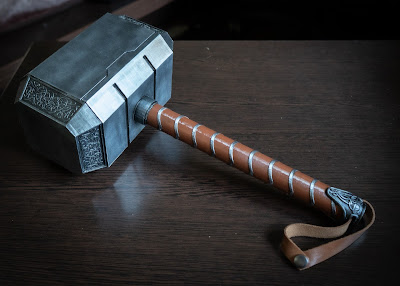
I'm Not Even Thor About This


It was a strange day.

We made a quick trip to pick up a new cell phone and ended up spending almost four hours with a self-professed Norse Pagan and a “Bad Gay” who frequents Chick-Fil-A with his husband.
The store doesn’t matter.

What does is, I came into contact and lengthy discussion with two people I might otherwise not have spent half a business day with, trying to force a cell tower into submission.

I’m changing their names to Tom and Bill for ease of use; their real names are much more colorful.
 
Tom, the Norse Pagan, has a lengthy ancestry traced to Charlemagne. He has an enormous knowledge of Norse mythology.
 
He does not approve of Chris Hemsworth and Tom Hiddleston in my beloved Marvel Cinematic Universe movies.
Not authentic. 
He is a Thor purist.

Bill is a laid-back nerd, who plays Pokémon like me (I am called ObiWanKenoBeth) and he coveted a recently-returned toy building set for World of Warcraft or Masters of the Universe or something like that. 
(My nerd-dom only extends so far, y’all.)

So, when Bill wasn’t looking, I bought it for him.

Because he was sweet and kind and spent four hours on the phone battling with invisible 5G overlords, so my husband’s phone might come to life.

I loved these guys.

I am grateful for life’s detours, which sit me next to Norse Pagans and Rebellious Gays for unexpected eons.

I’m reminded we are all different, we all have something to say, and most of all: we all help each other.

I hope Bill enjoys that Masters of the Pokémon Fortnite Warstuff building set, and always loves Chick-Fil-A as much as I do.
We all agreed they’re not homophobic and cook mighty fine sandwiches.

Most of all, Bill, Tom, Jay, and I found a forced half-day fun. We made it worthwhile and meaningful. We laughed together and understood one another better after our mutual confinement. 

And that, my friends, 
is worth more
than any cell phone
could ever be.


Love from Delta.

Saturday, October 31, 2020

Power to the People


We lost electricity in my house in the wee hours of Thursday morning, abruptly and with no fanfare. The internet went first, because at 2:40 am Alexa noticed a loss of connectivity and automatically/cruelly/inexplicably turned on my bedside lamp, which was interrogation-room bright in my sleeping face. I stumbled through the house manually switching off lights the AI decided must dilate my exasperated pupils. 

Maybe it was warning me of the darkness to come. The precious light I take for granted soon disappeared, along with every modern appliance and running water, because our well has an electric pump.

Being powerless was an inconvenience for the first day or so. Now it's a massive grievance I carry like a battery-powered chip on my shoulder. I just drove a mile to hand wash a few pieces of clothing far past their socially acceptable expiration date, and they're hanging on deck chairs to dry. My husband brings in massive containers of water so we can scoop it into toilet tanks for a precious flush.

This would all be much worse if I weren't married to a generator guru, who has figured out a way to power all the super-necessary stuff like WiFi and Netflix. It's cool enough outside to keep me from being non-air-conditioned homicidal. (Florida and its hurricanes brought me close to the edge in ninety-five degree heat more than once. I thought I was escaping all that, but Zeta tracked me to the mountains of northeast Alabama.)

I offered Mom popcorn last night and actually placed the bag in the microwave before realizing how futile my life is right now.

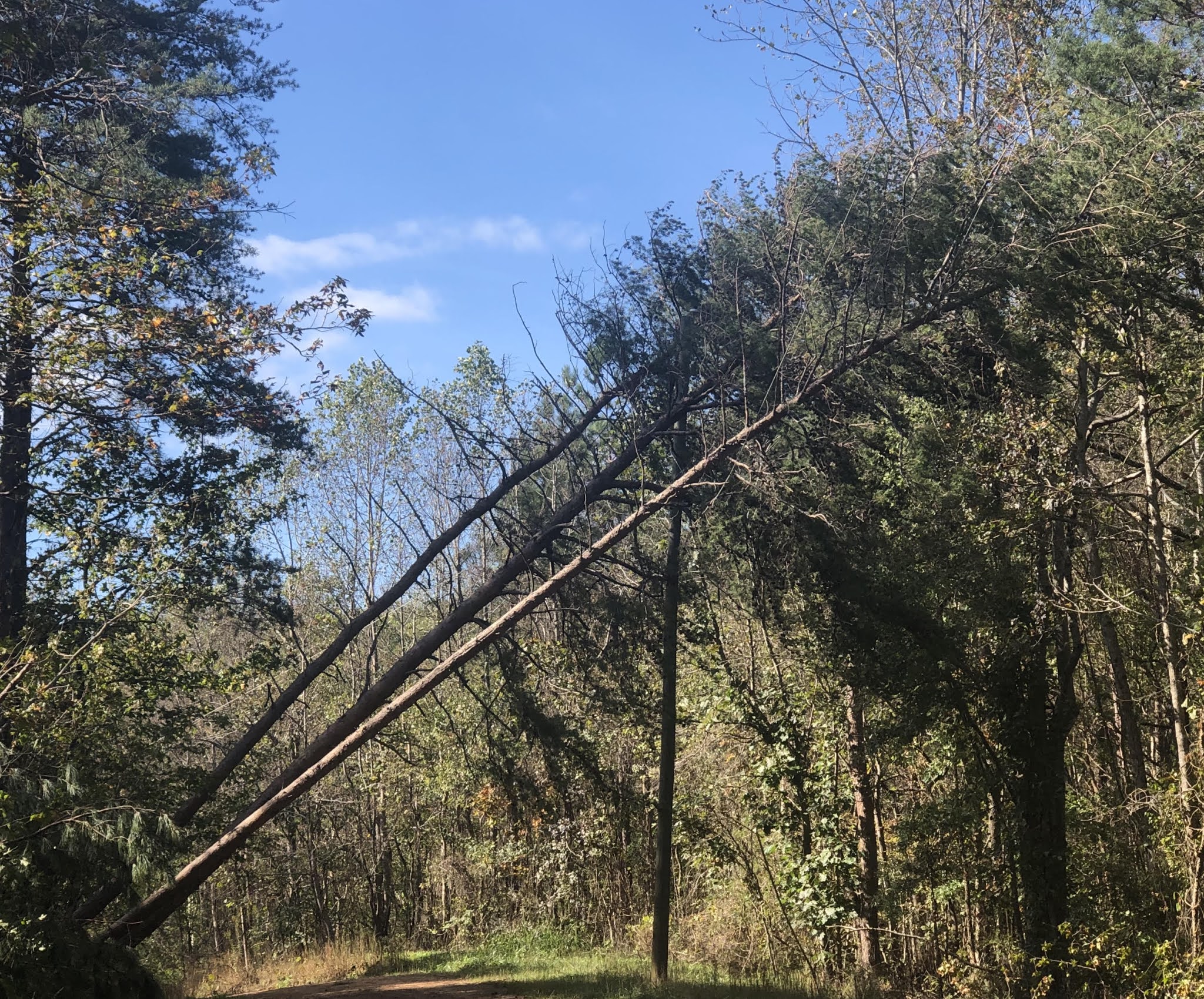
Alabama Power now says they expect to restore our electricity by 11:45 pm on November 5th, over one full week after this tropical storm blustered through our state. I am having a hard time with that. While I fully appreciate the hard work and dedication of countless people trying to restore power, I am less than delighted with their bosses and boss's bosses. The company has been non-responsive to me and all the friends I know who've tried to report outages or get updates, failing to keep their website and phone lines functional. Meanwhile, I'm driving daily under three massive trees that are solely supported by power lines near our house. Our neighbor's power pole is splintered like a shipwreck, its power lines a tangle of electrical kelp.

I am clearly reliant on modern conveniences like flush toilets and whatnot, and grateful to my generator guru husband. He's that kind of guy: a (male) friend Jay once rescued when his Jeep broke down said he had the wheel off, a tent set up and something roasting on a spit by the roadside within ten minutes. If Alabama Power won't charge up to my downed power lines within a week, at least I have this guy on a white horse wielding extension cords and water jugs.


Love from Delta.

Saturday, July 4, 2020

Colonials.


"COLONIAL"

It's being spray-painted across a lot of statues these days, including but not limited to George Washington's. 

George was, of course, the most anti-colonial of colonials. The men who fought to liberate the colonies from British rule risked absolutely everything to do so. 

I have ancestors who were among those men. On one branch of the family, brothers took different sides and the elder, a redcoat colonel, ended up preventing the execution of his captured rebel sibling (my many-times-great-grandfather). I am here by his grace, in this country, in this place and time, you might say. 

In another branch of the family, my ancestors were apparently true colonials, loyal enough to the crown to flee to Canada and wait things out, sipping their tea and glancing down to see when it might be a good time to circle back. (It's interesting to ponder what might have happened had we remained British colonies.)

"Colonial" conjures images of smug Brits being carried on the backs of native women. (This wasn't uncommon in the colonies of the Empire. It's ugly, but it's history.) We were British colonies, and we carried a lot on our backs, metaphorically, until we got tired of it in 1776 and decided we could determine our own, better way of life for all.

We hold these truths to be self-evident, that all men are created equal, that they are endowed by their Creator with certain unalienable Rights, that among these are Life, Liberty and the pursuit of Happiness.

Two hundred and forty-four years of the greatest experiment in human freedom is marked today. A country in which, for better or for worse, people of all colors and creeds and religions have come together to make their contributions to society. Make no mistake, they are some of the most glorious and diverse contributions in the history of the world.


A turbulent history gave birth to and developed The United States of America, and I still love her, warts and all. I love my friends and fellow Americans of all colors, and celebrate them.

We are together on this journey, and we have come so very far. Many, many persons of color are among the most accomplished and successful of our country in 2020. We are truly grateful for that.  

And, because the vast majority of Americans are goodhearted people, we want even better for every single one of us. We are an exceptional country.  

Excellence is the gradual result of always striving to do better, and we will do better. Two hundred and forty four years have taught us the lessons we need to know and remember. 

The hopes and dreams our ancestors held for us are woven into those lessons. Including my distant grandfather's, and I thank him for freedom and the opportunity to succeed in these beautiful United States of America.


Love from Delta.


Wednesday, May 27, 2020

Mrs. Storey


   Let me tell you where my heart and mind wandered when I read about the murder of George Floyd.

   You can’t avoid a frank discussion of racism in America in the face of this horror. There is no telling yourself we have abandoned this hideous relic of the past, that dust and cobwebs grow on its antiquated surface. 
   Not when the rest of it is so violently displayed, fresh and bitter, in the form of a knee on the neck of a handcuffed man.
   I don’t know what crime George Floyd was charged with. I haven’t investigated it, because nothing he could have done would merit this complete abandonment of human civility. Nothing could possibly counterbalance the sheer brutality of the Minneapolis police officer demonstrating his dominance over his captive, helpless prisoner.

   So, back to where this image leads me: to Annie Storey.
   When Mrs. Storey came to teach my sixth grade class in Weaver, Alabama, she did it at a time when black women didn’t teach white children in small towns. 
   We were kids, oblivious to the challenges she must have faced until we considered them years later.
   She was young and beautiful and so gifted at fascinating children with the solar system and European geography, we were spellbound. She was my favorite teacher. Many of my fellow students felt (and feel) the same.
   We loved her. We search for her to this day. 
   Mrs. Storey wasn’t our African-American teacher. 
   She wasn’t our black teacher. 
   She was our captivating and wonderful teacher, who commanded our respect and admiration every day.

   Annie Storey never said one word about racism, about not judging people by their skin color, about any of the segregationist sentiment that dominated Alabama at the time.
   She walked into our humble classroom every day in her fashionable A-line dresses, smiled at us with the warmth of that sun she showed us on the chart by the blackboard, and taught us we are all the same.
   So many years have passed. I remember her with love and enormous gratitude.
   I've memorialized her in two books with a character, Lily, inspired by her beauty and dignity.
   And I hope wherever she is, Annie Storey didn’t see what just happened in Minneapolis.
   
   It would break her heart.


Love from Delta.

Friday, May 10, 2019

My Mother Is Beautiful.

It's something I've heard all my life: "Your mother is so pretty."

There was a little boy in a department store who thought she looked like Eva Gabor. Might have been Zsa Zsa, but the kid was referencing Green Acres, I am pretty sure. I've heard Kim Novak suggested, too, and I personally think she's a little closer to target.

She has delicate features and lovely skin and a smile that warms the coldest room like a roaring fireplace. She has sparkling brown eyes a suitor once proclaimed "like pools of black ink." (He was not a poet.)

Her sartorial style is elegant and tasteful. She favors classics in beautiful colors and a vintage rhinestone brooch to sparkle alongside her.
Her sparkle wins. Every time.

These are all lovely attributes, but they don't constitute my mom's beauty. There is so much more than meets the eye when you're talking about an entirely beautiful person.

To see beyond, you'd have to know about the little girl in her Sunday School class years ago, who had perfectly serviceable parents of her own, but chose my mother to cling to constantly and regard as hers.
Because she saw Mom's heart.

You have to know about the ladybug houses she helped my Cousin Debi build, the adventures and projects she concocted to entertain an entire generation of my family.

About her fried baloney sandwiches made especially for my Cousin Hal.

About her incredible musicianship at a baby grand piano, and how she encouraged me to sing along even though cats have sounded better in midnight alleys.

She can produce an oil painting of flowers so detailed and vivid, they've been proudly displayed in other people's homes for generations.
She was about sixteen when she painted those roses.

You have to see her completing a crossword puzzle containing words no normal person has ever heard.
In record time. In ink.

You have to witness her love affair with books, which has translated into an astounding body of knowledge and a curiosity that is never sated.

Her lady in Publix who waits for her with a smile and a hug every time, or countless other people in countless other stores she frequents who light up when she walks in.
They call her by name.
They remember her because she's kind and they've witnessed that kindness over and over.

She is an extraordinary grandmother who took our toddler son into a North Carolina creek daily to move rocks that probably didn't need moving, but it was their project. Together.

Her granddaughter remembers Gran taking her downstairs to her meticulously tended garden at night to pay a magical, candlelit visit to a frog.

And I remember my mom, reading Hiawatha to me at bedtime, holding my hand through every joyful and heartbreaking thing in my life, building me up, making me laugh, constantly teaching kindness, thoughtfulness, thank you notes, generosity, and graciousness. 

She is love, in one lovely package.

My mother is beautiful.
Yours is, too, whether she's by your side or in your heart.

Happy Mother's Day.

One of my all time favorite photos: My mother with her mother and a couple of questionable characters


Love from Delta.

Tuesday, November 6, 2018

A Tree Grows in Alabama


My grandmother sat perched on the edge of her bed, smoothing her ivory chiffon skirt nervously. She looked like a porcelain doll, even at ninety-two. Lucile was the kind of woman who could wear head-to-toe lace-trimmed ivory anywhere but a funeral and look perfectly appropriate.


Her childhood was one of utter poverty. Her mother was widowed at a very young age and left with eight children to feed. My grandmother married at fifteen and bore her first child at sixteen. She read voraciously and was one of the best-educated people I knew, despite leaving school after eighth grade.


She was warm, loving and beautiful. Lucile was adored by us all, the heart of our family. As a toddler my mother would ask if I wanted to go to "Mama's." I didn't know about the apostrophe, so I called her Mamas all my life.

Mamas and Granddaddy were the center of the universe to their small grandchildren. We grew up pampered, encouraged, and assured of unconditional love. Granddaddy commissioned one of the first private in-ground swimming pools in the county for us to play in. He'd toss quarters into the deep end for us to dive and retrieve, a small fortune to us at the time. He would take me aside with a smile and hug me, whispering, "You're the best one I've got." I discovered later he did that with each grandchild, and loved him even more for it.

They left Alabama upon retirement for a small Florida town. Granddaddy was a borderline diabetic, but he chose to ignore the diabetic part and cling to the borderline.

We'd lost him to a heart attack many years before. It was my introduction to shattering loss, a time in my young life of utter confusion and despair. I stood outside and sobbed for an hour the night he died, asking God why he'd taken someone I loved so dearly.

He was buried in Arcadia, Florida, and now his family was scattered across several other states. Mamas had made the painful decision to have his remains exhumed and returned to his Alabama hometown. She was planning a service to honor him all over again in a few weeks. As a result we were all thinking about the part he'd played in our lives more than usual.

Today's mission—the one I couldn't bear to help with—was to locate a plot in the cemetery for Granddaddy with an adjacent one for Mamas. My grandmother planned a service for his reburial, and I was praying for the strength to help her through it in a few weeks.

She was still in fairly good health, but her trips to the hospital were becoming more frequent. None of us could bear the thought of losing her. We lived in fear of pneumonia and broken hips.

My mother poked her head into the room. "Are you ready, Mama?"

Mamas nodded and I helped her to her feet, trying to contain my tears and act cheerful. She wasn't fooled. "It'll be hard, honey, but I'll be fine." She kissed my cheek and squeezed my hand before taking Mother's arm and heading for the door.

I decided to clean house, my least favorite activity, to distract myself for the next few hours. I thought about the cemetery, wondering if they'd be able to find an acceptable space. I hoped my grandmother was feeling strong and faithful in her decision to bring Granddaddy home after almost thirty years. It was a very expensive and complicated process. Some people had openly questioned the idea, and she'd cried and prayed over it for months. Mamas had discussed her feelings with me several times. I'd encouraged her to follow her heart no matter what anyone said. It was to fall to me, the only grandchild able to attend, to represent all of my cousins that day. She wanted me to place a rose on his new grave as part of the ceremony. Burying Granddaddy again would be one of the saddest things I'd ever experience, but it was right to have him next to her for eternity.

When the phone rang, my mother’s excitement made me throw the dust rag down and collapse into a chair to listen.

“You would not believe what I’m looking at,” she said. “We stopped by the old house and the ginkgo biloba tree is huge and brilliant golden yellow. You can see it from a mile away.”

I pictured the three-foot-tall twig I’d known as a small child, carefully surrounded by sturdy wire fencing and forbidden to grandchildren. Granddaddy had fussed over it constantly but we never saw a single ginkgo leaf I could recall. The tree was a running joke; something to kid him about. He never gave up trying to make it grow, and it never obliged.

On a whim, Mother and Mamas had driven out of their way to visit the house my grandparents lived in during my childhood. The neighborhood we remembered was gone. Dilapidated houses remained with yards gone to seed. No children ran and played here; no one remained from the time we'd known and loved this as the warm, happy place we cherished in memory.

"It's the one beautiful thing here, Beth. It's at least thirty feet tall, and so very pretty. Your granddad would be so thrilled. Think how he fussed over that silly twig every day." We laughed a little, remembering the constant joking over his tree obsession.
We chatted for a minute about our memories of that place and how magical it was for all of us. Mom took a deep breath and said they needed to get to their appointment at the cemetery.

"I love you, Mother. Give my love to Mamas. I'm so glad about Granddaddy's ginkgo."
I closed my eyes and pictured all the cousins arrayed on the steps of that house, we girls in ruffled Easter dresses with legs akimbo and most unladylike. I remembered the rare winter when the pool froze over and we "skated" across it in socks. The hours and hours we'd spent playing at my grandfather's desk, pretending we were businesspeople. The joy of gathering at the table to play hours of Rook, munching on popcorn Granddaddy popped atop the stove. Gathering pecans in the side yard, helping my grandmother water her beloved flowers. Every bit was as vivid as yesterday.

Still, I was trying to catch the wisp of something long forgotten. The tree. Something about the tree. It had to have had some special significance, the way Granddaddy fussed over and protected it. It was a story I'd been told as a young girl, not fully understood or appreciated.

Tears rolled down my face before I even realized I'd remembered.

Before I was born, my grandmother had thyroid cancer. Her future was uncertain at best and the family was terrified of losing her. Autumn was bleak. Mamas grew depressed and defeated, too weak to do anything but lie on the couch. My mother spent endless days caring for her, praying for a miracle and trying to make her smile.

Mother still hates autumn to this day. She experiences it as a time when the world is dying, turning to dull brown and losing its summer joy. I have no doubt her feeling is rooted in that dark season so long ago.

Emory University Hospital in Atlanta was my grandmother's best option for treatment. It lay two hours away, but Grandaddy took her back and forth several times a month. It was a grueling time for her; my mother told me Mamas had been offered little hope for a cure.

In mid-November she saw the magnificent ginkgo biloba trees on the Emory campus burst into color. She was fascinated by the delicate fan-shaped leaves and their brilliant golden canopy. They transformed the plain landscape; they welcomed her each time to the doctors and nurses who worked so hard to heal her.
Grandaddy noticed the light in her eyes when she looked at them. He did what any man in love with his wife would do, though it took him on a lengthy and difficult search in 1950's Alabama.

Somehow he located a rare ginkgo and planted a tiny sapling for her, a symbol of his love for Lucile and his hope for their future together, right in that modest Alabama front yard. His proudest legacy—children, grandchildren and great-grandchildren—had scattered like fall leaves across the south and never beheld what became of his precious little fenced-in plant. We'd forgotten it, lost among the memories of family laughter and love.

Granddaddy had lived in Florida for many years before he went home to God. He never saw the ginkgo biloba soar to its towering glory for the world to behold, but my grandmother did . . . at the perfect, breathtaking moment. And she knew without question she'd made the right choice to bring him home, to the place and the woman he'd always love.


Granddaddy's Ginkgo


Love from Delta.
www.bethduke.com